
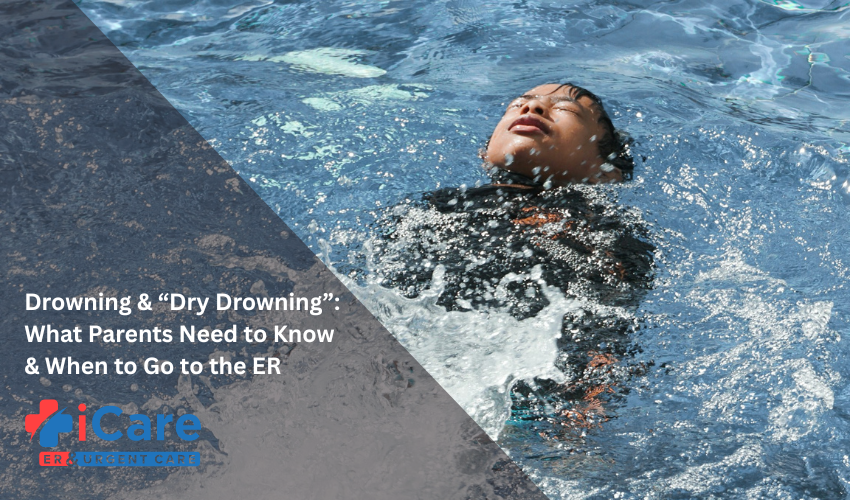
Water activities are a common part of summer fun, but drowning remains one of the leading causes of accidental injury and death in children. Many parents have also heard the term “dry drowning,” which can create confusion and anxiety after a child experiences a water-related incident.
Understanding the warning signs after a near-drowning event and knowing when to seek emergency medical care can help parents respond quickly and confidently.
At iCare ER & Urgent Care, our medical team evaluates and treats children and adults experiencing breathing problems and other complications related to water accidents.
What Is “Dry Drowning”?
“Dry drowning” is not an official medical diagnosis, but the term is commonly used to describe breathing complications that develop after a child inhales water during a near-drowning event.
Water entering the airway can irritate the lungs and make breathing difficult, even after leaving the water. Symptoms usually appear within a short period of time after the incident rather than days later.
While serious complications after water exposure are uncommon, any breathing problems following a near-drowning incident should be taken seriously.
Signs and Symptoms After a Water Incident
Children should be monitored closely after any significant water-related accident.
Warning signs may include:
- Persistent coughing
- Difficulty breathing
- Wheezing
- Chest pain
- Extreme fatigue or drowsiness
- Vomiting
- Confusion or unusual behavior
A child who appears unusually tired or struggles to breathe after being in the water should be evaluated immediately.
When to Go to the Emergency Room
Emergency medical care is necessary if a child develops serious symptoms after a water incident.
Go to the emergency room immediately if your child experiences:
- Severe difficulty breathing
- Blue lips or skin
- Persistent coughing that does not improve
- Loss of consciousness
- Confusion or difficulty waking up
- Severe chest pain
These symptoms may indicate dangerous respiratory complications requiring immediate treatment.
If a child stops breathing or becomes unresponsive, call 911 immediately.
What Happens in the Emergency Room?
Emergency medical providers will evaluate the child’s breathing, oxygen levels, and overall condition.
Depending on symptoms, treatment may include:
- Oxygen therapy
- Breathing treatments
- Chest X-rays or other imaging
- Observation and monitoring
Some children may need to remain under observation for several hours to ensure symptoms do not worsen.
In severe cases, hospitalization may be necessary.
What to Watch for at Home
If a child appears normal after a brief water incident, parents should still continue monitoring for symptoms during the next several hours.
Watch for:
- Increased coughing
- Trouble breathing
- Unusual sleepiness
- Vomiting
- Behavioral changes
If any concerning symptoms develop, medical evaluation is recommended.
Water Safety Tips for Parents
Many drowning accidents can be prevented with proper supervision and water safety precautions.
Helpful safety tips include:
- Never leave children unattended near water
- Use life jackets when appropriate
- Install pool fences and locked gates
- Teach children basic swimming skills
- Avoid distractions while supervising swimmers
Even children who know how to swim should always be supervised around water.
Higher Risk Situations
Certain situations increase the risk of drowning complications, including:
- Swimming without supervision
- Diving accidents
- Boating incidents
- Young children near pools or bathtubs
Children can silently slip underwater in seconds, which is why constant supervision is critical.
iCare ER & Urgent Care: Emergency Care for Water-Related Injuries
Breathing problems after a water incident should never be ignored. Prompt evaluation can help identify complications early and ensure proper treatment.
At iCare ER & Urgent Care, our experienced medical team provides emergency evaluation and treatment for respiratory distress and water-related injuries. With locations in Frisco, Forney, and Fort Worth, we offer both urgent care and emergency services for children and adults.
Walk-ins are welcome, and emergency care is available 24/7.
Frequently Asked Questions
Can symptoms appear after leaving the water?
Yes. Some breathing problems may develop shortly after a near-drowning event, which is why monitoring is important.
What symptoms should parents watch for?
Parents should watch for coughing, breathing difficulty, unusual fatigue, vomiting, or changes in behavior.
Is “dry drowning” common?
Serious delayed complications after water exposure are uncommon, but any breathing symptoms after a water incident should be evaluated.
When should I call 911?
Call 911 if a child has severe breathing problems, blue lips, loss of consciousness, or becomes unresponsive.
Conclusion
Water-related accidents can quickly become serious emergencies. Understanding the warning signs after a near-drowning incident and knowing when to seek emergency care can help protect children from dangerous complications.
If breathing problems or unusual symptoms develop after a water incident, prompt medical evaluation is essential.